Transformation Needs Thousands of Conversations
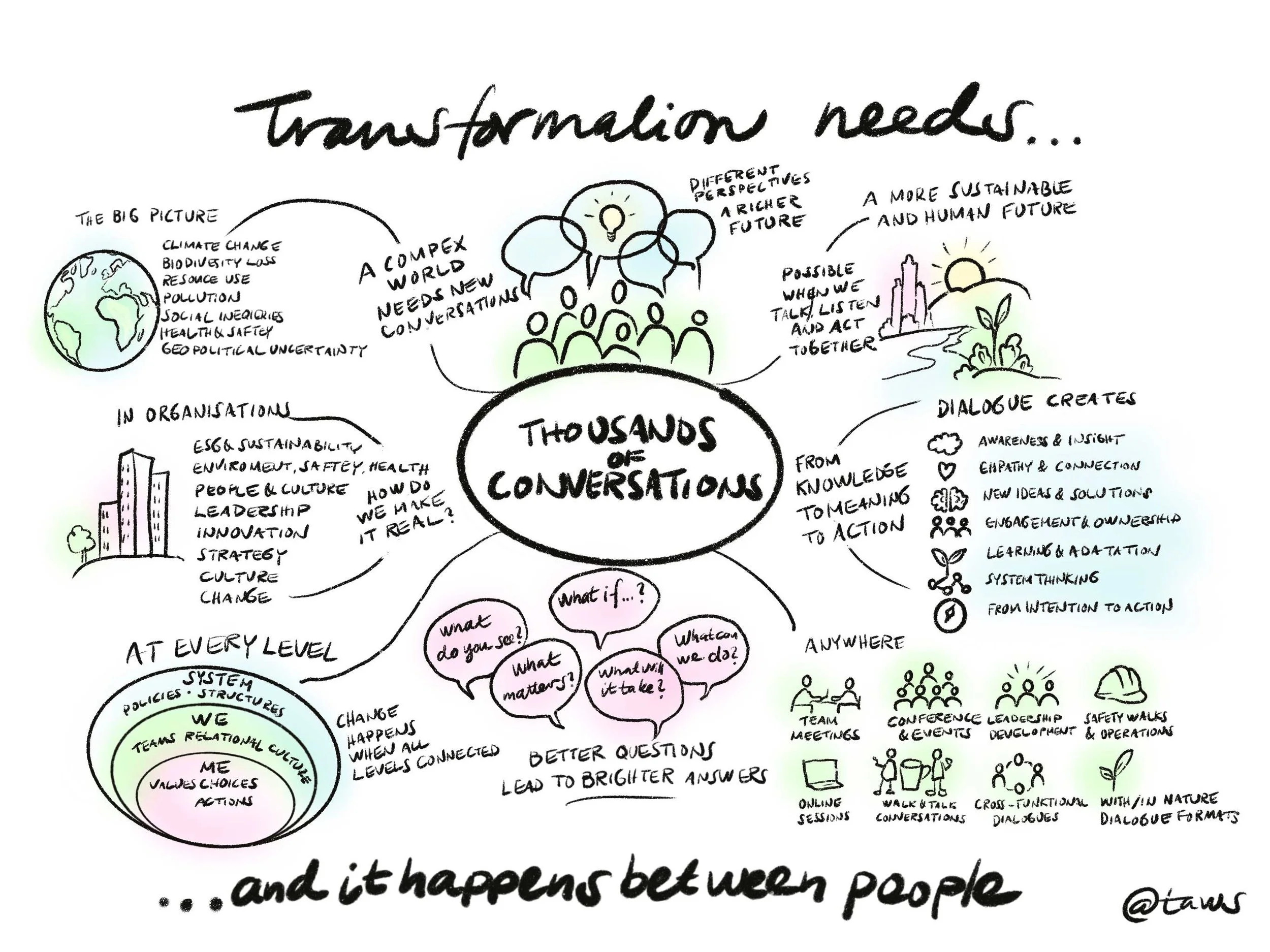
Copyright Illustration by Anna Taws
How dialogue can turn sustainability, strategy and transformation into something people actually live
Organisations don't transform because a new strategy has been launched.
Sustainability doesn't become part of a company because new targets have been set.
And culture doesn't change because people have attended a presentation.
Transformation has to become lived.
It has to move from strategies, frameworks and PowerPoints into conversations, decisions, relationships and everyday actions.
That is why I believe transformation needs thousands of conversations.
The missing space between strategy and action
Companies invest enormous energy in defining where they want to go.
ESG strategies. Sustainability targets. Health & Safety programmes. Leadership principles. Cultural transformations. New organisational structures.
But between organisational ambition and everyday action is a space we sometimes underestimate:
the human space.
People have to make sense of what the transformation means.
They have to connect it to their own work.
They have to talk about tensions and trade-offs.
They have to question assumptions, listen to perspectives different from their own and translate broad ambitions into choices they can actually make.
This is not simply communication.
It is dialogue.
From communicating transformation to creating participation
A traditional approach to organisational change often asks:
How do we communicate this to our people?
A more participatory question is:
What conversations do our people need to have for this transformation to become meaningful and actionable?
That shift matters.
People are no longer simply recipients of a transformation designed somewhere else in the organisation.
They become participants in making it real.
And this is where deliberately designed conversations can become a powerful part of transformation.
Dialogue as transformation infrastructure
Every organisation already contains thousands of conversations.
Between colleagues. Across departments. During leadership meetings, safety walks, conferences, onboarding, workshops and coffee breaks.
But what if we began to think more intentionally about their quality?
What questions are we asking?
Who gets to speak?
Whose perspectives are missing?
Are we creating room for uncertainty and disagreement?
Are we connecting organisational goals with people's lived experience?
Are insights travelling across organisational boundaries?
This is what interests me about conversational design: intentionally designing the conditions for the conversations an organisation needs.
A good dialogue doesn't tell people what to think.
It helps them think together.
Sustainability has to become personal
Sustainability is a good example.
We have increasingly sophisticated knowledge, frameworks, reporting requirements, targets and data.
All of this matters.
But sustainability cannot live only in the sustainability department.
It has to enter procurement conversations, product decisions, leadership meetings, innovation processes, operations, HR and everyday choices throughout the organisation.
For that to happen, people need opportunities to explore questions such as:
What does sustainability mean in my role?
Where do our ambitions collide with everyday realities?
What are we currently not talking about?
What can we influence together?
What would acting on what we already know actually require from us?
The conversation connects the organisational ambition with human agency.
ESG and EHS are also human systems
The same applies to ESG and Environment, Health & Safety.
Frameworks, indicators and procedures provide important structures.
But much of the intelligence needed for change is distributed among people.
Someone notices a weak signal.
Someone sees a risk before it appears in the data.
Someone understands why a procedure doesn't quite work in practice.
Someone sees a contradiction between a sustainability ambition and a commercial decision.
Someone has an idea but doesn't normally have a space to voice it.
Dialogue helps organisations access this distributed intelligence.
It can become a form of organisational sensing.
Everybody knows something. Nobody knows everything.
The role of HR and People & Culture
This also makes dialogue highly relevant for HR, People & Culture and leadership development.
Transformation asks something of people.
The ability to navigate uncertainty.
To listen.
To disagree constructively.
To collaborate across differences.
To see systems and connections.
To reflect on our own assumptions.
To make decisions when there is no perfect answer.
To turn intention into action.
These are not secondary “soft skills”.
They are capacities for transformation.
HR and People & Culture can play an important role in creating the spaces where these capacities are practised – not as abstract competencies, but through conversations about the organisation's real challenges.
Conferences can become places of participation
The same principle applies to conferences and large internal gatherings.
A conference can deliver extraordinary speakers, insights and inspiration.
But what happens between the input and the participant?
Often, very little.
We listen. We take notes. Perhaps we talk briefly over coffee. Then the next presentation begins.
Imagine instead deliberately creating moments throughout a conference where participants turn towards one another.
A strong question.
A dialogue card.
Ten minutes with someone from another part of the organisation.
A dilemma connected to the keynote they have just heard.
A conversation about:
What does this mean for us?
Suddenly, participants are not only consuming content.
They are processing it together.
The conference becomes a place for collective sensemaking.
Dialogue cards as conversation starters
This is why I work with dialogue cards and facilitated conversation formats.
A dialogue card is a small intervention.
But a carefully designed question can do something important.
It can interrupt habitual thinking.
Invite a quieter voice into the conversation.
Make an uncomfortable tension discussable.
Connect a large systemic challenge with personal experience.
Or help people move from:
What do I think?
to
What are we noticing together?
to
What might we do?
I often structure this movement as:
ME → WE → SYSTEM
What does this ask of me?
What does it ask of us?
And what needs to change in the wider system around us?
Imagine 10,000 conversations
Now imagine a transformation programme with an additional ambition:
10,000 meaningful conversations.
Not 10,000 workshops.
And not conversations controlled by a script.
Instead, create simple dialogue formats that can travel throughout the organisation.
Three cards at a team meeting.
A 15-minute conversation following a keynote.
A dilemma explored during leadership development.
Dialogue stations at a conference.
Questions integrated into safety walks.
Cross-functional conversations around ESG challenges.
A facilitated session during a strategy day.
Each conversation is small.
Together, they create movement.
They allow ideas to travel horizontally rather than only from the top down.
They surface tensions and possibilities.
They strengthen relationships.
They help people understand why transformation matters – and discover where they themselves have agency.
And over time, conversations can begin to shape culture.
From workshop to dialogue architecture
This is where I see the greatest potential.
Rather than thinking about dialogue as a single workshop, we can design a dialogue architecture around a transformation.
Depending on the organisation, this might include customised dialogue cards, facilitated sessions, conference interventions, leadership conversations, team formats, facilitator training and ways of harvesting insights across the organisation.
The questions are designed around the transformation itself.
Sustainability.
ESG.
Health & Safety.
Culture.
Leadership.
Ethical dilemmas.
Organisational change.
And the format can scale from one table to thousands of employees.
The purpose is not to manufacture agreement.
It is to strengthen an organisation's capacity to listen, reflect, make sense, learn and act together.
Make transformation conversational
We need strategies.
We need targets.
We need data, expertise, policies and plans.
But if we want transformation to live inside an organisation, we also need to pay attention to what happens between people.
So alongside:
What is our transformation strategy?
perhaps we should start asking:
What conversations need to happen for this transformation to become real?
And then design for them.
Because transformation doesn't become culture when people have heard about it.
It becomes culture when people start talking, thinking and acting differently together.
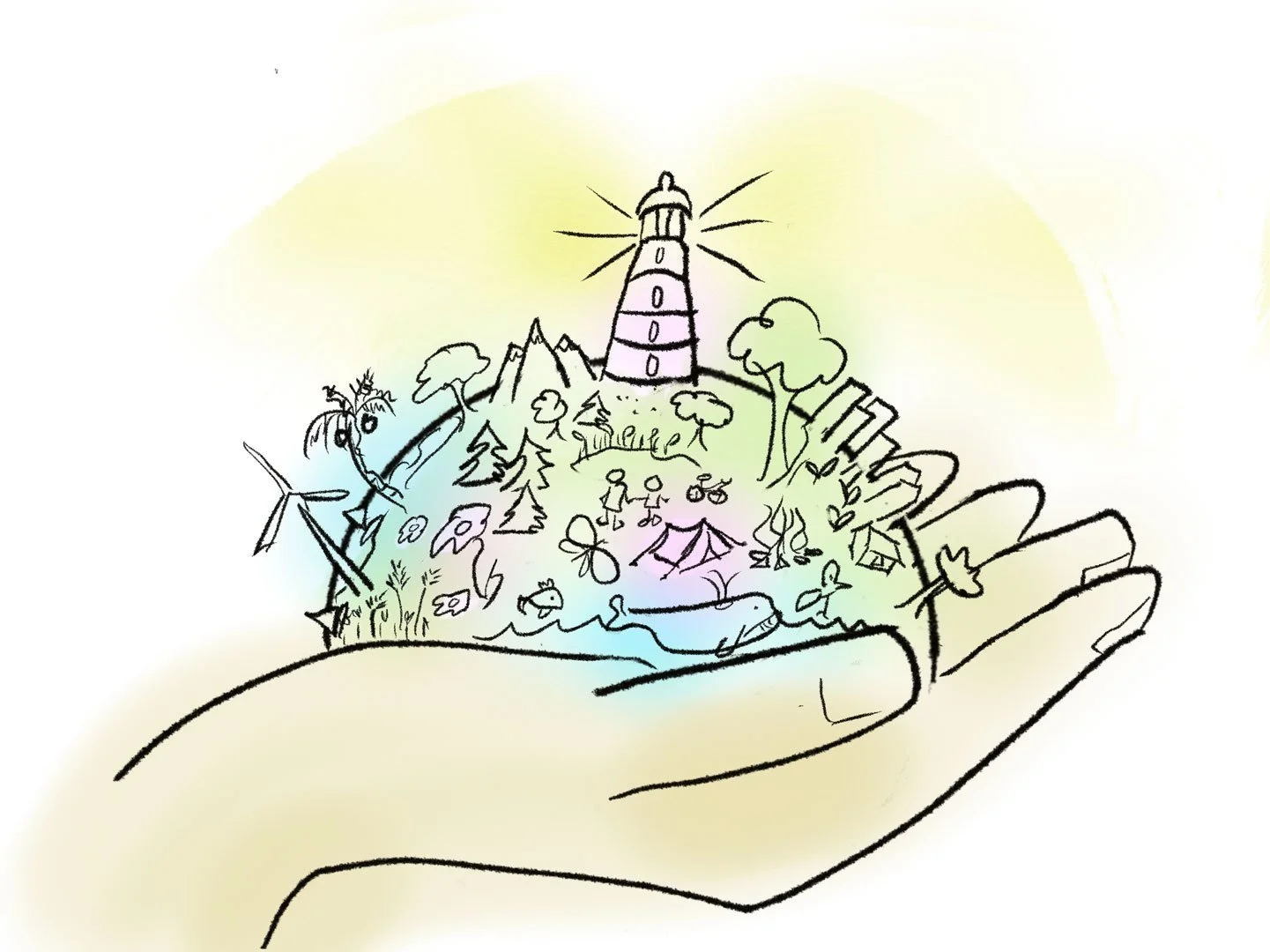
What conversations does your organisation need?
If you’re working with sustainability, ESG, EHS, People & Culture or organisational transformation, I design and facilitate dialogue formats that turn strategy into meaningful conversations across your organisation.
From a conference intervention or leadership session to customised dialogue cards and organisation-wide formats.
Let’s design the conversations that make transformation live.. Please connect